

Brief/Overview
Hellscape was developed by a team of 3 first year SAE students over 12 weeks and was released September 02, 2020. Hellscape is a Luftrausers inspired rougelike game, filled with environmental hazards and Demon’s armed to the teeth with attacks unique to each enemy type. Your primary objective is to eliminate the hivemind Demon Brain, survival is optional…
This brief was an introduction to team work, mixing designers and programmers together in order to familiarise ourselves with the processes involved in collaborative work. This was the first project I have worked on in a team setting and it facilitated a scenario similar to that of studio production.

Contributions and Intention
Team Position
I took the role as team leader within this project, ensuring that work was being completed up to standard and on time. I was in charge of project specific deadlines, encouraging good work and spent a large amount of time developing the game alongside my team. I worked on a range of different feature’s and visuals throughout the project including; AI, UI, Weapons, Modular Vehicle Systems, Objective Systems and so on. Due to the large amount of work I have done, I will only cover features and systems that allowed me to learn important lessons in Game Design and Project Workflow.
AI
I created two unique AI, a standard enemy type that shoots out X shaped lasers (Fire Sigil) and a boss enemy type that switches between three separate attacks (Demon Brain).
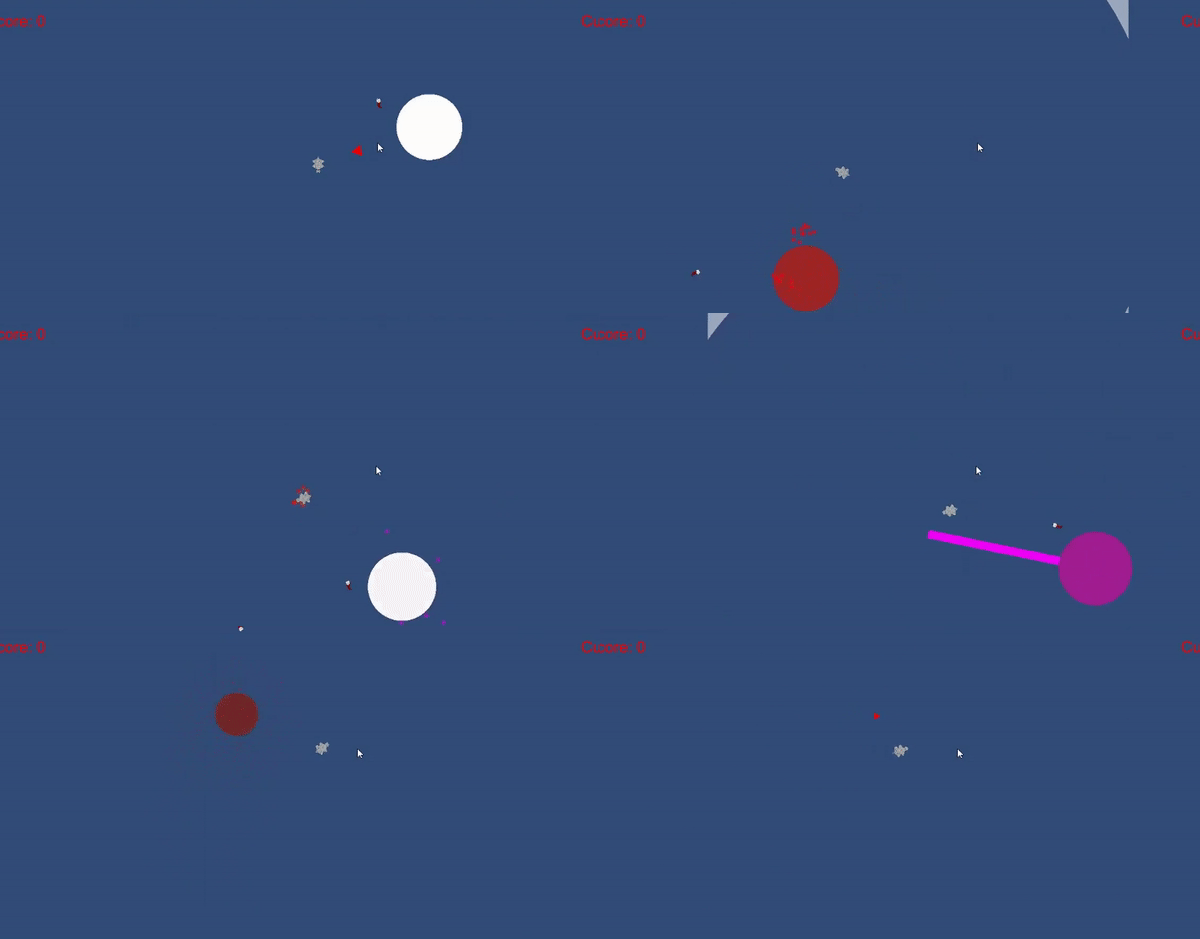
The Fire Sigil is the second enemy type the player will encounter and will always spawn in pairs. The pairs were important for this enemy type as the X shaped lasers are designed to trap the player and limit their movement. One Sigil is easy to escape, however, two either side of the player proves challenging.
While the Fire Sigil is moving, it will keep up with the player no matter their speed, making it the hardest enemy to escape. Once they fire, however, they will become immobile and easy to target. A more skilled player will be able to easily predict when they will fire and just as easily counter their attacks.

The Demon Brain was the final enemy and proves the hardest for the player to combat. The first two of the Demon Brain attacks are similar to the standard enemy types in the game. This was done intentionally as the player would have already developed techniques to counter these types of attacks. By tweaking them slightly, the Demon Brain encounter facilitates a challenge for the player to test their mastery.
The attacks that the Demon Brain can use will increase as its health decreases. This gives the player time to learn each attack and acts as a subtle indicator for it’s health. They are also weighted so that the more powerful attacks are used less frequently to give the player a chance. Each attack has a unique charge up sound effect, animation and, particle effect to clearly inform the player which attack will be coming next.
The first attack is a fireball barrage that shoots between 2-3 oversized fireballs in the direction of the player. This attack is similar to the third enemy type the player encounters (Fallen Angels). The second is a laser that quickly follows the player wherever they go, similar to the Fire Sigil’s. The final attack pulls in any nearby objects before blasting them away and temporarily disabling control. This attack is unique to the demon brain and is unforgiving as the player has a high chance of landing in the lava below.
Game Systems
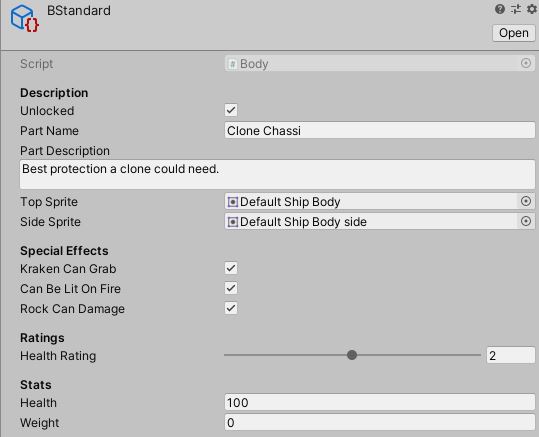
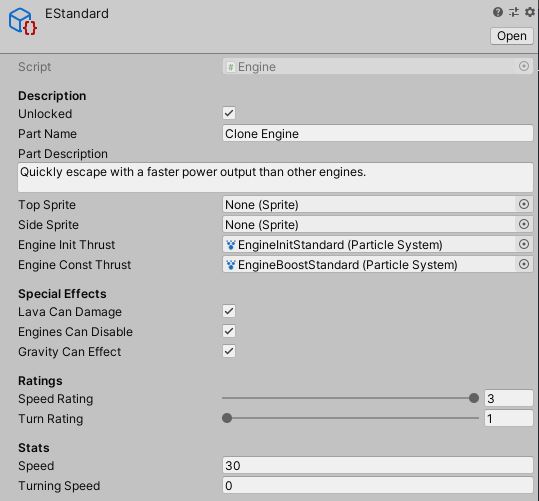
I worked on a Modular Vehicle System that used Scriptable Objects (SO) to store unique audio-visual representations and functionality of the weapon, body and thruster parts. By using SO’s I was able to easily create variants of parts within the project files and add them to a global list. The Player Controller and any relevant UI would read from this list and update dynamically. The below screenshots show the SO and UI counterparts.



Weapons
I created two unique weapons with the intention of giving the player a chance to try different play styles. It was important while creating these to ensure that each weapon’s damage, speed and attack radius (if applicable) was balanced. Each weapon strived to be different, not more powerful.
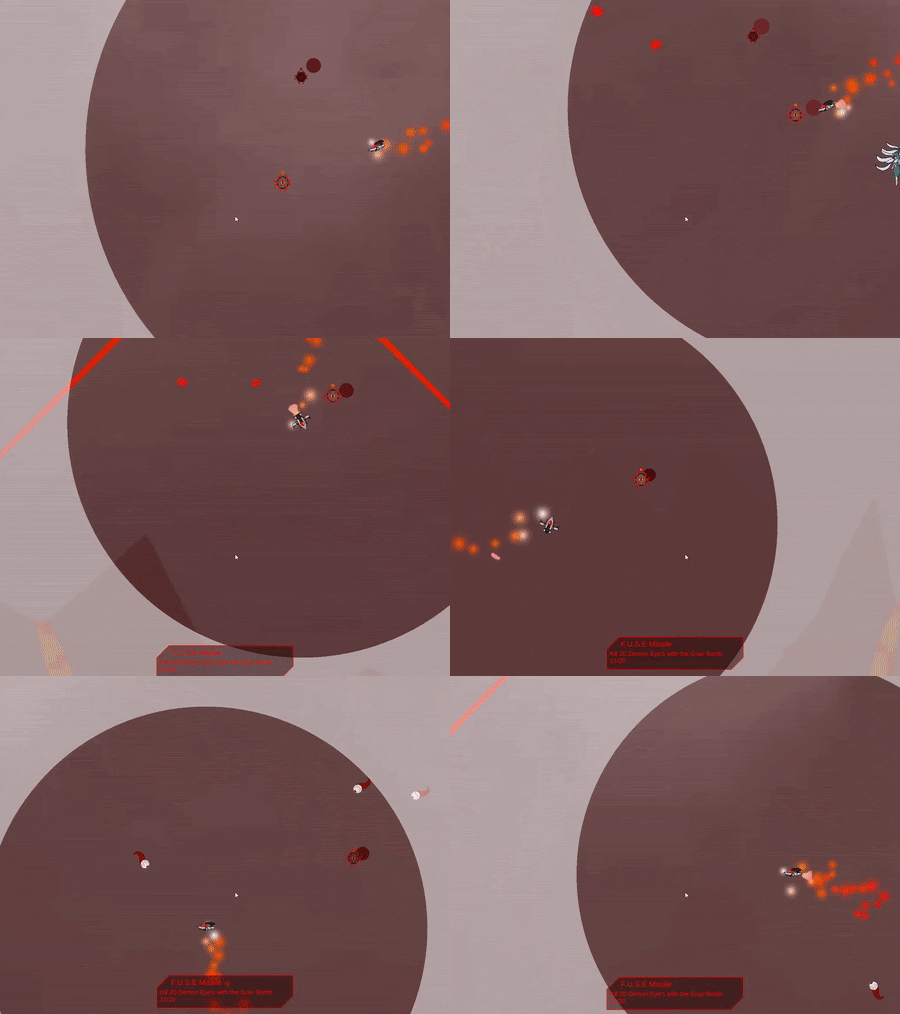
The second weapon the player can use (Target Painter) shoots three projectiles, two small warheads and a large penetrating marker. The marker would set any enemy it hit as a target and the other two would rapidly chase it, exploding on impact.
I designed this weapon to give player’s a chance to attack from longer ranges, supporting the sniper/mid range playstyle. The player needs to have good aim as it is easy to miss your target, however, if a target is hit the warheads deal enough damage to take them out in 2 hits. This allows the player to strategically take out enemies from a safer distance.
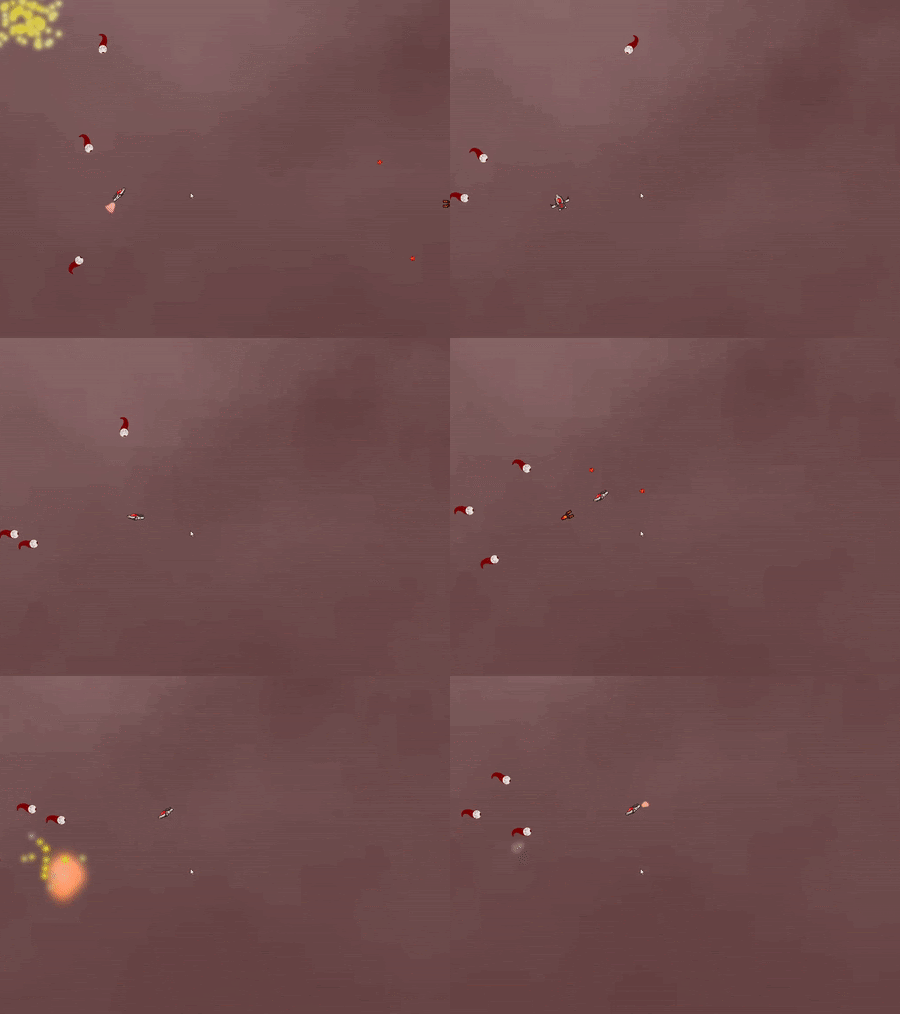
The third weapon the player can use (Grav Bomb) sticks to any hostile it hits and pulls in nearby enemies, exploding after a few seconds.
I designed this weapon to support the rusher playstyle. Due to the slower projectile speed, it is easier to quickly fly by and attach the bomb to an enemy, letting the gravitational pull do the rest. It also allows the player to group enemies together and deal devastating AOE damage.
Other Features
- Missions and Unlocks
- Score Tracker
- Part Functionality and Passive Effects
- Persistent Data
- Boundaries and Player Redirection
- Environmental Hazards
- All UI / UX
- Background Art
- Range of SFX’s
- Range of Particle Systems

Main Learning Outcomes
Leadership Skills
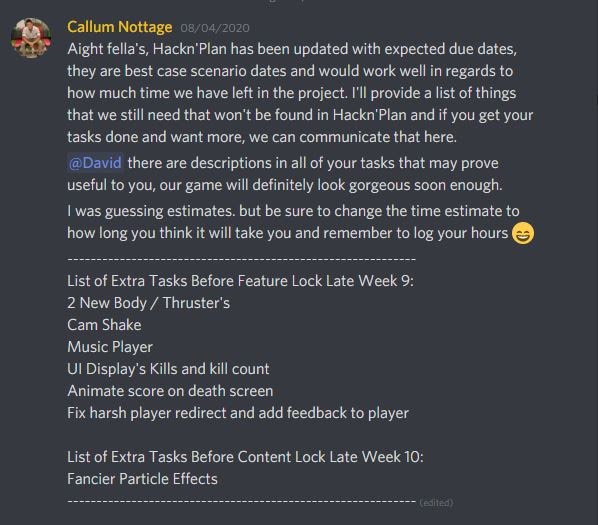
During the course of the project, I was able to learn and exercise a range of leadership skills. I used Discord as the main platform for communication with my team and Hackn’Plan to track and assign tasks.
Throughout the 12 weeks, I was consistently involved with the project and communicative with each team member. On multiple occasions, I would hold one on one meetings with each member in order to assist them with any task that they needed help with.
Through direct instruction from my facilitator, I was able to apply techniques that encouraged consistent work and open communication. These techniques included; holding mid-week meetings, showcasing progress, giving deadlines on each task, providing and updating priority lists and, providing assistance when required.
Scriptable Object Architecture
In a research activity that I had to undertake while working on the project, I came across Scriptable Object (SO) Architecture. As discussed previously, this workflow was used for the Modular Part System and Mission Tracking System, proving valuable in future projects as well. I watched the below GDC talk by Ryan Hipple and was able to apply the concept into this project.
Below you can find my research document, summarising the points in the above video and providing examples on how I can apply what I have learnt.
AI Development
While I improved in a vast range of skills, AI programming and design was an area I improved in the most. Before creating the Fire Sigil and Demon Brain (detailed above), I did a handful of research into AI. Through my research, I have familiarised myself with a couple of concepts, Goal Orientated Action Planning (GOAP) and Combat Behaviour / Racial Personalities.
I used a range of resources in my research, however, the main two pieces of literature that had the most impact on my findings can be seen below.
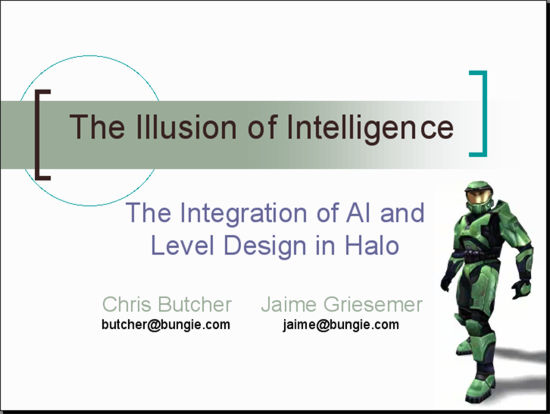
A talk covering Combat Behaviour / Racial Personalities by Bungie employees, Chris Butcher and Jaime Griesemer: The Illusion of Intelligence.
A talk covering GOAP by an AI Programmer at Monolith Productions, Peter Higley.
Below is a quick overview of the theory I learnt
- AI should be predictable
- AI should communicate their state to the player using ‘barks’
- AI should interact with the environment
- Allow the player to do anything the AI can
- AI should react to the player’s actions
- AI are worth remembering if they have meaningful goals / personalities
- Allow AI personality to drive behaviour
With both AI, I applied some of this theory, mainly predictability and ‘barks.’ By using SFX’s, animations and, particle systems I was able to ensure that the player could always predict when the enemy will be attacking. The time between the start of the ‘bark’ and the output of the attack would always remain the same, giving the player ample opportunity to react.
I mentioned previously that the Fire Sigil’s work best in pairs as they can trap the player between their lasers. In hind sight, I had an opportunity to add Racial Personality to these enemy types. If I designed them to work as pairs rather than individuals, they would always attempt to trap the player and if one of the pair is defeated, the other could go berserk.
By doing this, the Fire Sigil’s would have a unique dynamic and reaction to the player’s actions. This in turn would make them more interesting and memorable. Through analysis of other AI and my own work, as demonstrated here, I aim to constantly improve and develop my skills.
Finally, I learnt about Finite State Machines (FSM) and how to apply them in C# and the Unity3D engine. I used Unity’s Finite State Machine Tutorial to introduce me to the practical side of this concept, applying it to the attack class of the Demon Brain.

 Callum Nottage